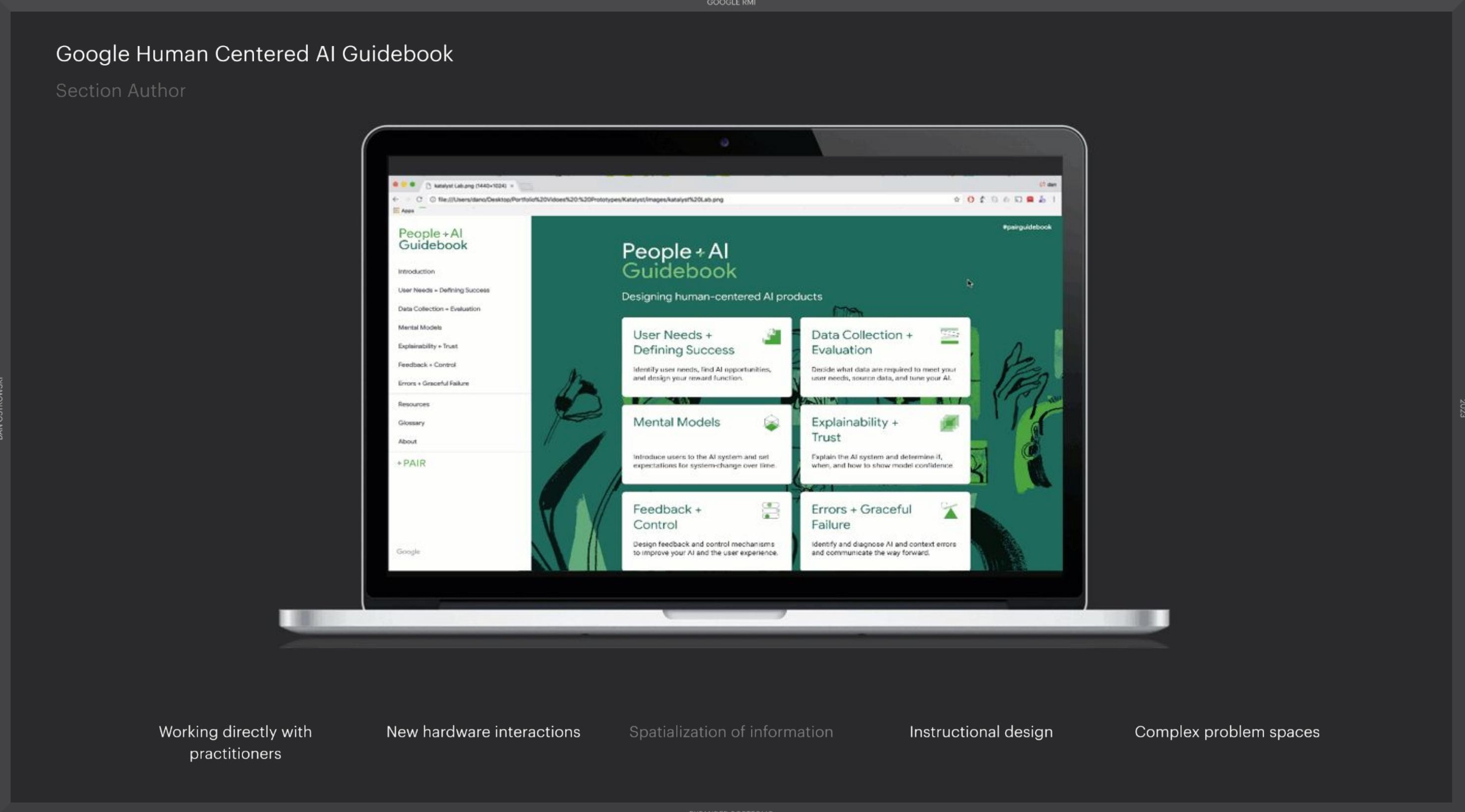
People + AI Guidebook
I didn't just co-lead the Errors and Failures section. I introduced a new framing for the field — one drawn not from software design, but from aviation disaster.
The People + AI Guidebook — published by Google's PAIR (People + AI Research) team and available publicly at pair.withgoogle.com — was one of the first comprehensive references for human-centered AI design. It defined patterns for how AI systems should communicate uncertainty, handle errors, set user expectations, and recover from failures.
I contributed to the Errors and Failures section — the part of the Guidebook that addressed what happens when AI systems go wrong.
The Contribution
The conventional framing of AI errors in 2019 was largely borrowed from software UX: show an error message, offer a retry, provide a fallback. That framing assumed discrete, recognizable failure states — the system either worked or it didn't.
I brought a different frame: aviation disaster analysis. Specifically, Air France Flight 447 — the 2009 crash caused not by a single system failure but by a cascade of conflicting signals that collapsed the crew's ability to form a coherent mental model of what the aircraft was doing.
The flight's autopilot had disconnected due to iced pitot tubes. In the 4 minutes and 24 seconds before impact, the crew received contradictory readings from multiple instruments, conflicting aural warnings, and an unreliable airspeed indication. They were not incompetent. They were operating in a system that had been designed without accounting for the cognitive cost of conflicting signals at the moment of maximum stress.
The most dangerous AI failure isn't the system going down. It's the system giving two answers that can't both be right — and leaving the human to figure out which one to trust.
The Interaction Pattern
The pattern I authored for the Guidebook: conflicting signal hierarchies.
When an AI system receives inputs that generate contradictory outputs — or when the system's confidence in its own output falls below a threshold — the design response should not be to silently resolve the conflict and present a single answer. It should be to surface the disagreement explicitly, label the sources of conflict, and give the human the information they need to reconstruct their mental model quickly.
This pattern has three components:
- Signal visibility — show the competing signals, not just the resolved output. The human should know what the system is weighing.
- Confidence calibration — when system confidence is low, communicate that directly. Don't present uncertain outputs with the same visual weight as certain ones.
- Mental model support — give the human enough context to form their own hypothesis. The goal isn't to offload decision-making — it's to ensure the human can take back control when the system can't be trusted.
Why It Mattered Then and Now
In 2019, this pattern was forward-looking. Most AI products didn't yet face the complexity of genuinely conflicting signal hierarchies — the models weren't capable enough to generate convincingly wrong answers, and the stakes were low enough that the failure modes didn't matter much.
In 2026, with agentic AI systems operating in production code, financial systems, and medical contexts, this pattern is urgent. An autonomous agent that silently resolves a conflict in its context window and proceeds without surfacing that conflict to the human is an Air France 447 waiting to happen.
The pattern I authored in 2019 became a design requirement I applied directly in Mendel Traffic in 2026 — where the question of when an AI experiment agent should surface disagreement to the engineer versus silently resolve it is exactly the design problem at the center of the work.
The Guidebook
The People + AI Guidebook was referenced by product teams across Google during AI integration reviews and became one of the field's most-cited references for responsible AI UX. It's available publicly and remains relevant.