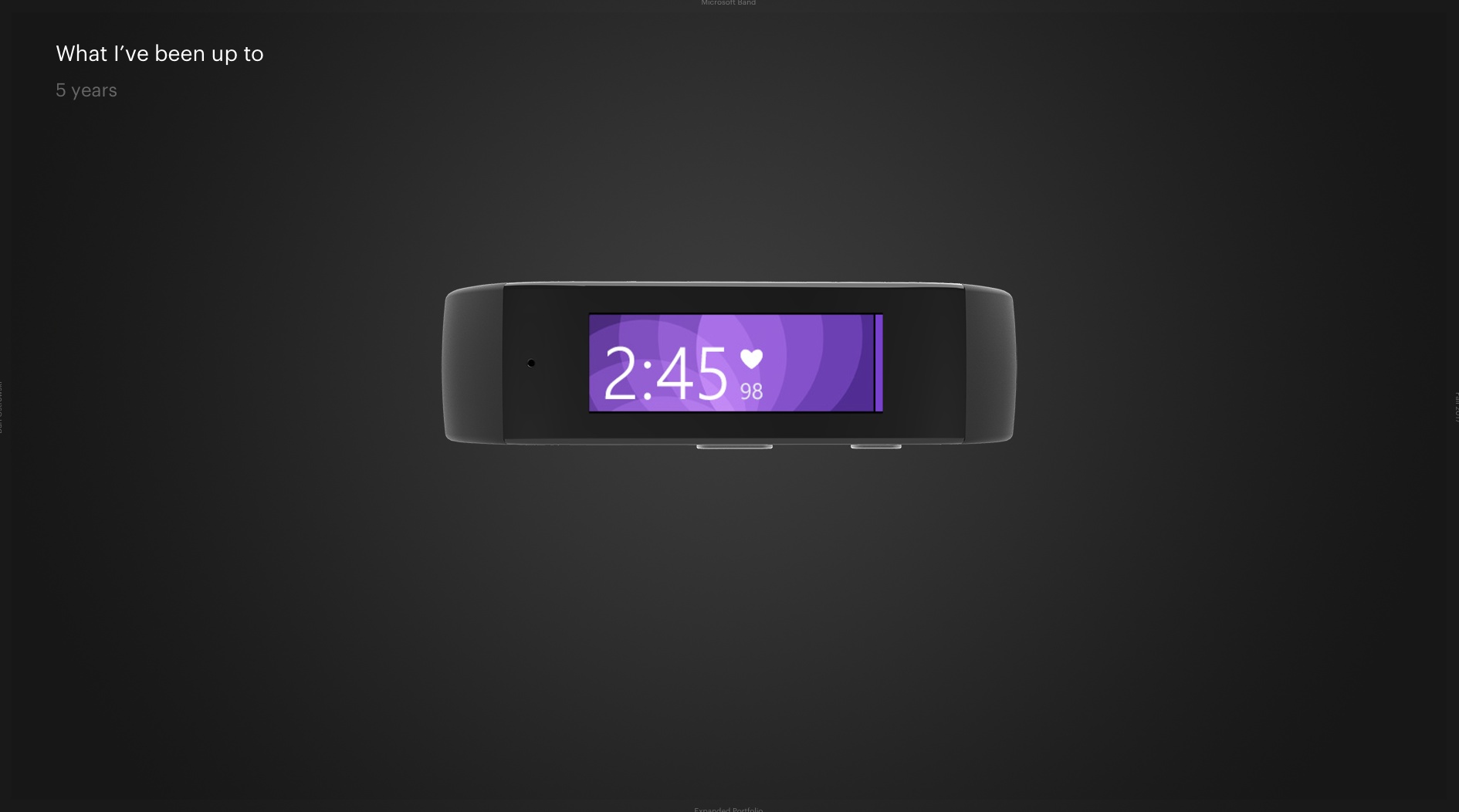
Microsoft Band 1
Device constraints eliminated conventional input entirely. What we built instead was a new theory of how humans communicate with machines under extreme physical restriction.
I joined Microsoft as the first designer on a three-person incubation team. The brief was open-ended: design the experience for a wearable computing platform. The constraint was not: a touch surface roughly the size of a stick of gum, with two to four active sensors per row, on a device worn on the wrist during physical activity.
Conventional input was impossible. A QWERTY keyboard at that scale was physically unusable. Predictive text required a gesture vocabulary the device couldn't support. We had to invent something new.
The Constraint as Design Brief
The Band's touch surface measured approximately 11×33mm — smaller than a postage stamp. We had capacitive sensors arranged in a 2×4 grid, enough to detect tap location but not enough to resolve individual characters. The compute budget was tight. The battery was tighter.
Most teams would have scoped the product down: no text input, no messaging, notifications only. We asked a different question: what if we designed a completely new input paradigm that worked within the constraint rather than around it?
The Input Paradigm
Working with Microsoft Research, we developed a system we called Wordflow. The core insight: on a tiny touch surface, the location of a tap is more information-rich than the tap itself. If you know where someone's thumb lands — even imprecisely — you can apply pattern recognition to infer what they were trying to type.
The system worked in three stages:
- Pattern recognition on tap location — each tap registered a position on the 2×4 grid, not a character. The system analyzed sequences of positions against a language model.
- Probabilistic sentence inference — rather than showing individual character candidates, the system surfaced complete word and sentence candidates ranked by likelihood. The language model did the disambiguation work that the hardware couldn't.
- Single-gesture approval — the user confirmed a candidate with a single swipe. If the top candidate was wrong, a scroll revealed alternatives. The interaction took seconds rather than the minutes a character-by-character approach would have required.
This wasn't a smaller keyboard. It was a fundamentally different theory of input — one that treated the hardware limitation as a design constraint that forced a better solution.
The Broader Experience
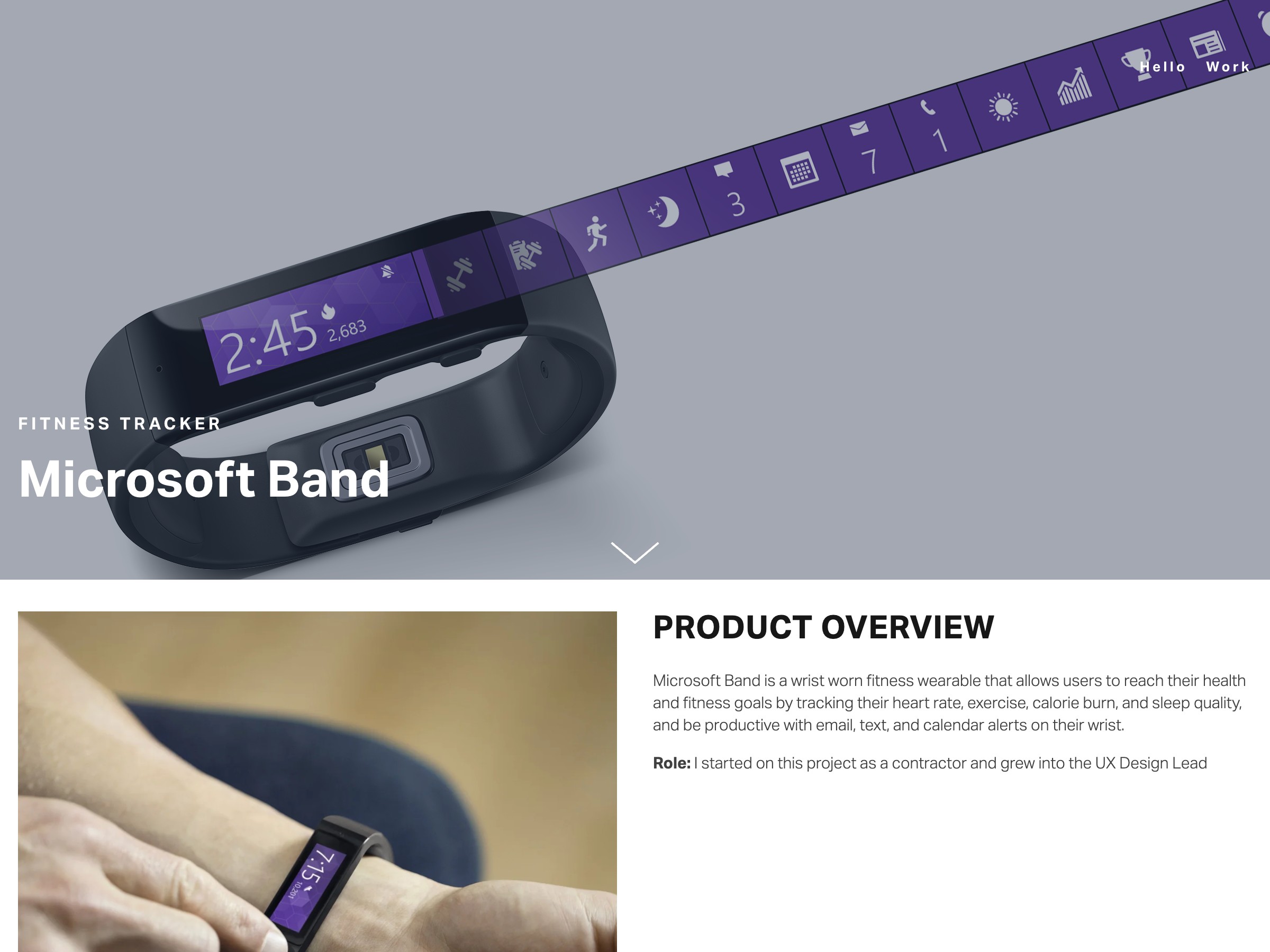
The keyboard was one piece of a larger system we designed from scratch. The Band was Microsoft's first serious wearable, and we were defining what a wearable experience could be before the category had established conventions.
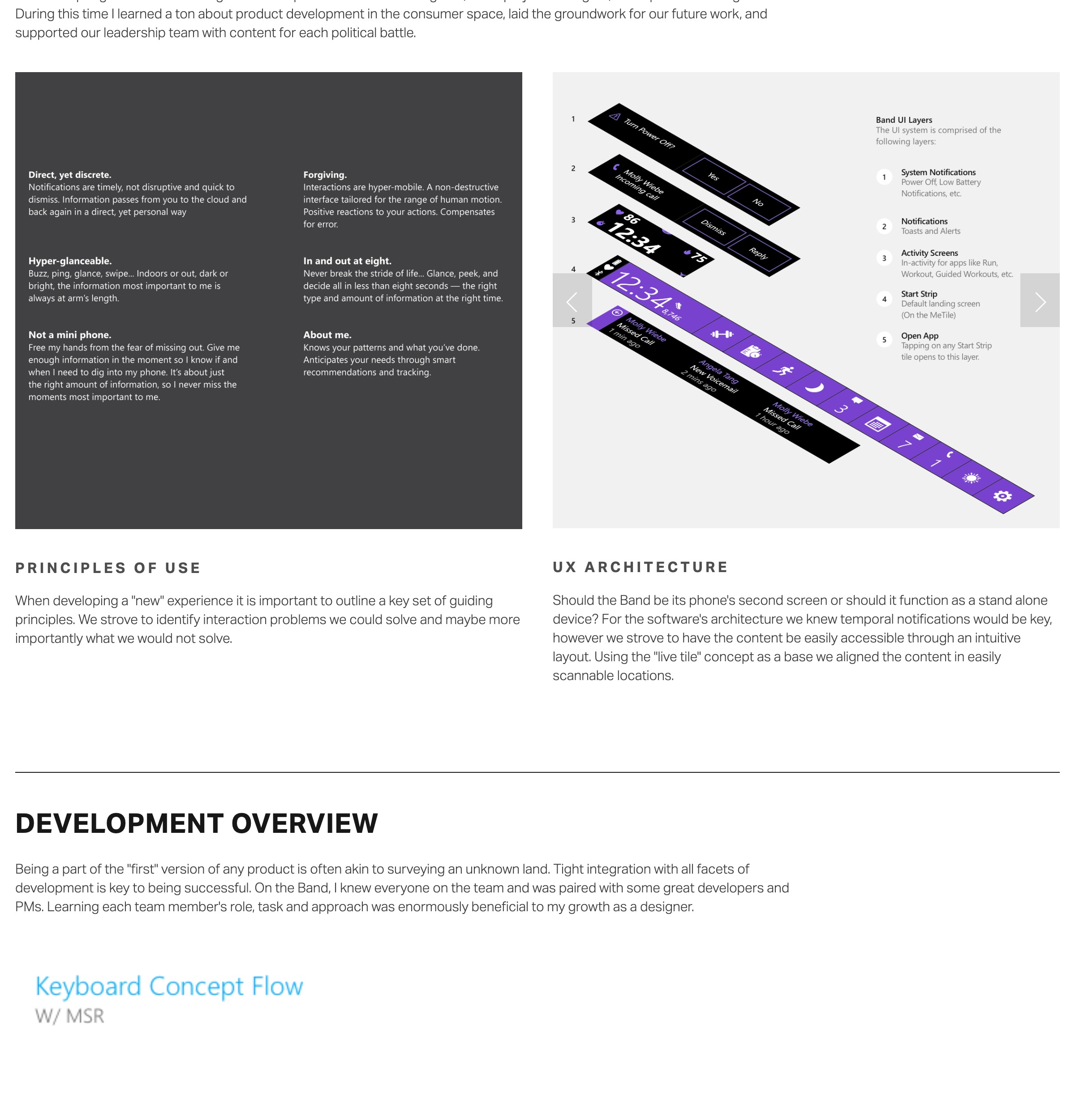
We developed a haptic language — distinct patterns for notifications, alerts, and coaching cues — that communicated meaning without requiring the user to look at the screen. We designed tile-based navigation that could be operated with a single thumb while running. We built a coaching framework drawing on BJ Fogg's behavior design principles, using the device's continuous sensor stream to time nudges at moments of maximum receptivity.
The UX work was done in constant collaboration with hardware engineers and firmware developers. When the compute budget changed, interaction patterns changed with it. When a sensor proved unreliable in cold weather, we redesigned the interactions that depended on it. Design and engineering were not sequential here — they were simultaneous.
What This Taught Me
Extreme constraint forces extreme clarity about what actually matters. When you can't do everything, you discover what's essential.
The Band taught me that the friction point is the design opportunity. Every time we hit a hardware wall, we had to ask: is this a constraint we work around, or a constraint we design through? The Wordflow keyboard came from choosing the second option.
It also taught me something about the relationship between hardware and interaction design. The best interactions we shipped weren't designed on top of the hardware — they were designed from inside its constraints. Understanding what the sensors could and couldn't do, what the compute budget allowed and didn't allow, was not a limitation on creativity. It was the source of it.
Band 1 shipped in October 2014. It sold out on the first day.